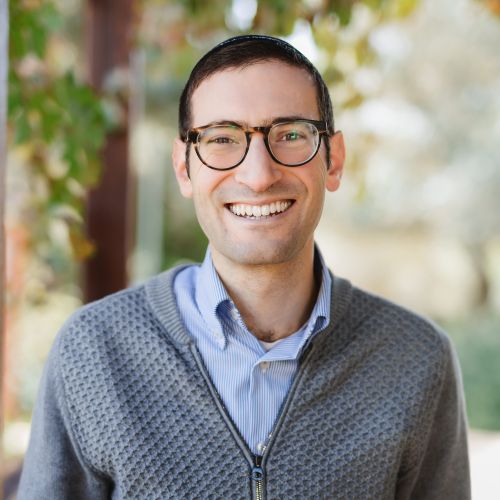
Aminadav Grossman
Credentials
Licensed in Israel
Finances
- HaArbel 35
- Kiryat Gat
 Verified
Credentials
Social Worker
MSW
Finances
250-350 NIS
None
N/A
ABOUT THE THERAPIST
I focus on empowering clients to help themselves by cultivating self-awareness and developing tools for lasting change. Alongside my work as a therapist, I serve as the mental health professional on staff at two gap year yeshivot
I have a background in Cognitive Behavioral Therapy, helping clients recognize the interaction between thoughts, feelings, and behaviors. I also help clients integrate past experiences into their current worldview.
I serve as the mental health professional on staff for overseas gap year students at an Israeli hesder yeshiva. I have extensive experience helping individuals with anxiety, relationship concerns, self-esteem, family dynamics, and major life decisions and transitions — including aliyah, entering military service, and other significant identity-shaping choices.
I practice a client-centered approach to therapy, where the client remains in the driver’s seat. My role is to provide reflection, support, and gentle challenge to help identify and shift unhelpful patterns.
QUALIFICATIONS
MSW
Wurzweiler School of Social Work
2021
Degree
MSWEducation
Wurzweiler School of Social WorkYear of Graduation
2021Years in Practice
5
LICENSED IN ISRAEL
Registered Social Worker in Israel
41211
DISTANCE COUNSELING
Online Therapy
PRIMARY SPECIALTIES
Anxiety / Panic
Family Issues
Life Transitions
Self-Esteem
ADDITIONAL SPECIALTIES
Couples / Relationship / Marriage Counseling
Divorce / Custody
Grief
Parenting Issues / Training
Spiritual Concerns
CLIENT FOCUS
Population
Adolescents
Adults
Families
Men
Languages Spoken
English
Hebrew
Native Language
English
TREATMENT APPROACH
Cognitive Behavioral Therapy (CBT)Cognitive Behavioral Therapy (CBT) is a type of psychotherapy that focuses on how one's thoughts, feelings and behaviors are connected and can be changed. It is based on the idea that how we think (cognition) and how we feel (emotion) can influence how we behave. CBT helps people identify and challenge distorted thinking and replace it with more balanced thinking, leading to improved mood and behavior. ‘Homework’, usually containing practical writing exercises, is often completed by the client between sessions to reinforce the therapy. Examples of tools that practitioners often use are journaling, challenging beliefs, and mindfulness.
Narrative TherapyNarrative therapy is a form of psychotherapy that focuses on the stories, or narratives, of a person's life in order to help them gain insights into their situation and develop skills to make positive changes. It is based on the idea that people construct their own stories and meanings to make sense of their lives and experiences. It emphasizes the strengths, values, and skills of the person, while also exploring the influences of culture and context on their life. Narrative therapy seeks to empower individuals by helping them to identify and use their inner resources to overcome challenges and create positive change.
Person-Centered Therapy (Rogerian Therapy)Person-centered therapy, or Rogerian therapy, was developed by Carl Rogers in the 1940’s. It is a form of talk therapy that emphasizes the importance of providing psychological safety, unconditional positive regard, and empathic understanding to clients. This type of therapy is based on the belief that individuals have an innate capacity for self-actualization and self-understanding and that the therapist's role is to provide a supportive environment in which this process can take place. Through the use of active listening, open-ended questions, and non-judgmental reflection, the therapist helps the client to explore their thoughts, feelings, and experiences in a safe and accepting environment. By doing so, clients are able to gain insight into their issues, develop a greater understanding of themselves, and work towards personal growth.
SERVICES OFFERED
Individual Therapy
Hadrachat Horim
Therapist's Experience with Gap Year Students
In addition to my work in a therapy clinics and private practice, I serve as mental health professional on staff at Yeshivat Har Etzion working with students struggling with anxiety, depression, OCD, social anxiety, challenges in relationships, adapting and organizational skills, and major decision making.